When a New World Was Already Home
Greetings from The Melancholy Muse—though perhaps The Confused Muse would be more accurate.
History often leaves me with more questions than answers. As a student of history, I am continually amazed by the stories historians tell—and equally fascinated by the stories they often leave untold.
History is not merely the rise and fall of nations or the victories of kings. It is the widow left to raise three children after her husband dies in battle. It is the frightened child who survives a war he never understood. It is the countless ordinary people whose names never appear in textbooks, but whose suffering shaped every generation that followed.
Those forgotten lives are history, too.
Every story begins somewhere in time and place. This one begins with a simple question that has echoed through centuries: Who really “discovered” America?
The question raises another: what does “discovery” mean? Is the premise itself mistaken? Indigenous peoples did not wait for Europeans to give their homelands meaning. They had migrated, settled, built communities, named places, and developed relationships with the land long before European ships appeared. When European explorers arrived, however, they believed they had discovered new lands and could claim them for kings and crowns.
My previous article asked, “Who Owns This Land?” The question here follows naturally: how can someone claim to have discovered a land already inhabited by people who knew it as home? To the explorers, the land was new. To the people standing on the shore, it was not.
History often tells us who discovered a place. It rarely asks who was already home.
For generations, American schoolchildren learned a simple sentence: Christopher Columbus discovered America in 1492. It is easy to remember. It is also worth examining.
Columbus certainly accomplished something extraordinary. In October 1492, after crossing an ocean whose size he had badly underestimated, he reached islands of the Caribbean. His voyage helped establish a sustained connection between worlds that had developed largely apart from one another. The consequences would eventually reach nearly every corner of the earth.
But did Columbus discover America? That depends upon what we mean by discovered.
Someone Was Already Home
When Columbus stepped ashore on October 12, 1492, he did not enter an empty wilderness. He encountered people. The inhabitants of the islands he first encountered are commonly identified with the Lucayan Taíno, part of the much larger Indigenous world of the Caribbean. They had homes, families, communities, political relationships, religious beliefs, technologies, trade networks, and generations of accumulated knowledge about the land and sea around them.
They knew where they were. Columbus did not. Even Columbus’s own account makes their presence impossible to ignore. He described the people he encountered, their appearance, possessions, canoes, behavior, and exchanges with the Europeans.
So perhaps the question needs to change. Instead of asking simply, “Who discovered America?” perhaps we should ask: Who discovered whom?

October 12, 1492
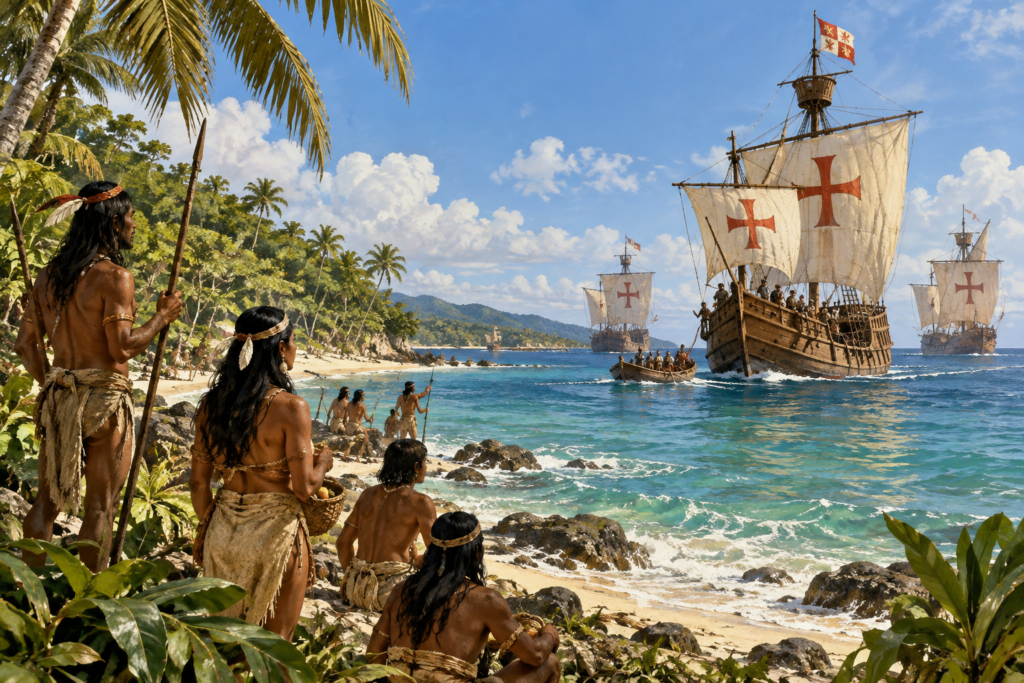
Columbus’s fleet—the Niña, Pinta, and Santa María—had been sailing westward from the Canary Islands for more than a month when land was sighted. The island on which Columbus first landed was called Guanahani by its inhabitants. Columbus renamed it San Salvador.
Naming was not merely a matter of navigation. European explorers repeatedly named lands, rivers, islands, and coastlines they encountered. Names could become declarations of possession, authority, religion, and empire.
The people already living there had not suddenly acquired a homeland on October 12. Europe had acquired knowledge of their homeland. Those are not quite the same thing.
What Columbus Thought He Had Found
Columbus himself did not believe he had discovered a previously unknown continent. He was trying to reach Asia. His calculations of the earth’s size and the distance westward to Asia were badly mistaken. When he encountered the Caribbean islands, he interpreted them within the geographical framework he already possessed. This helps explain the term “Indians.”
Columbus believed the people he encountered belonged to the world Europeans associated with the Indies. The name survived long after Europeans understood that they had encountered continents previously unknown to them. A mistaken geographical assumption became a label applied to millions of different people. Words have long lives.
Discovery and Possession
European monarchies did not merely want geographical knowledge. They sought trade, wealth, strategic advantage, converts, and territory. Columbus sailed under the authority of Ferdinand and Isabella of Spain. When he reached the islands, he claimed them for the Spanish Crown.
But consider the scene from the perspective of the people standing on the shore. Foreign ships appeared. Strangers came ashore. They performed ceremonies, raised banners, and announced possession. Yet the inhabitants had not surrendered their land.
This exposes a fundamental collision between worlds. One side believed that discovery, royal authority, Christian claims, and formal ceremonies could establish possession. The other side was already living there.
They were not discovered. They were found without warning.
Columbus Was Not the First
Long before Columbus crossed the Atlantic, the continents later called the Americas were already inhabited. Indigenous peoples had lived, traveled, traded, governed, worshiped, farmed, hunted, and built communities here for thousands of years. Their histories did not begin in 1492.
Nor was Columbus the first European known to have reached North America. Norse voyagers reached the continent centuries earlier, leaving archaeological evidence at L’Anse aux Meadows around the year 1000. Their contact, however, did not produce the lasting transatlantic connection that followed the voyages beginning in 1492.
That distinction matters. Columbus’s historical importance does not depend upon pretending that nobody was here before him. His voyages were transformative because they helped initiate sustained contact between Europe and the Americas.
A World Changed
After 1492, neither side of the Atlantic would ever be the same. Plants, animals, diseases, technologies, religions, languages, and peoples crossed the ocean in what historians call the Columbian Exchange.
Europe received foods that would eventually transform diets and populations. The Americas received horses, cattle, pigs, wheat, and many other Old World species. But the exchange was anything but equal.
Old World diseases—including smallpox—devastated Indigenous populations that lacked previous exposure to them. Warfare, forced labor, enslavement, displacement, and colonial expansion compounded the catastrophe. European empires grew while Indigenous societies struggled to survive a transformation they had never chosen.
Yet they did survive. That fact is also part of the story.
So, Who Discovered America?
Perhaps there is no satisfactory one-name answer. The ancestors of Indigenous peoples reached and populated the Americas thousands of years before Columbus. Norse voyagers crossed the Atlantic centuries before him. Columbus crossed it in 1492 and helped establish a sustained connection between Europe and the Americas that transformed world history.
All three statements can be true.
History becomes distorted when we believe that recognizing one requires erasing another. Christopher Columbus does not need to be made either a saint or a monster to understand his importance. He needs to be placed in his world. So do the people he encountered. And perhaps that is the more interesting history.
On October 12, 1492, Columbus looked toward a shoreline and saw a land Europeans did not know. The people on that shoreline looked back and saw strangers arriving from the sea.
Can a land already inhabited by human beings truly be “discovered”? Does knowing about a place give someone the right to possess it? When does exploration become conquest? When does missionary activity become entangled with political power? And perhaps the most important question: whose voice have we heard when history tells us what happened? Who writes the history?
The Word “Discovery”
Perhaps the problem is not simply Columbus. Perhaps part of the problem is the word discovery. From a European perspective, Columbus’s voyage revealed lands previously unknown to most Europeans. From the perspective of the people already living there, nothing had been discovered. Their world had been encountered.
Calling 1492 an encounter does not erase Columbus’s achievement or the enormous historical importance of his voyages. It simply places the people standing on both sides of the shoreline back into the story.
America was not an empty world waiting to be found. It was already home.
A Voice of Protest: Bartolomé de Las Casas
One of the most important early European voices to challenge the treatment of Indigenous peoples was Bartolomé de Las Casas. He participated in the Spanish colonial world before becoming one of its most famous critics. He eventually condemned the brutal treatment of Indigenous peoples and argued that they possessed reason, humanity, and rights that Christians were obligated to recognize.
His writings are not neutral documents. Like every historical source, they must be examined critically. But they are enormously important because they demonstrate that the morality of conquest was not merely questioned centuries later. It was questioned at the time. Europeans themselves argued over conquest, conversion, sovereignty, and human dignity.
That debate deserves its own investigation—including the response of European rulers and churchmen when conquest collided with Christian claims about the humanity of the people being conquered.
Why the Question Still Matters
The debate over America’s “discovery” is not merely an argument about a word. It is a question about historical memory: who gets to tell the story, whose names survive, and whose world disappears from the telling.
The Melancholy Muse explores the overlooked stories of history—especially those that challenge accepted narratives. Every article begins with a question, follows the historical evidence wherever it leads, and invites readers to think critically, discuss respectfully, and continue the journey of discovery.
Next: Who Defends the Peoples of the Land?
Until then… Follow the Muse.
With every sunset comes a sunrise.
— The Muse Den